
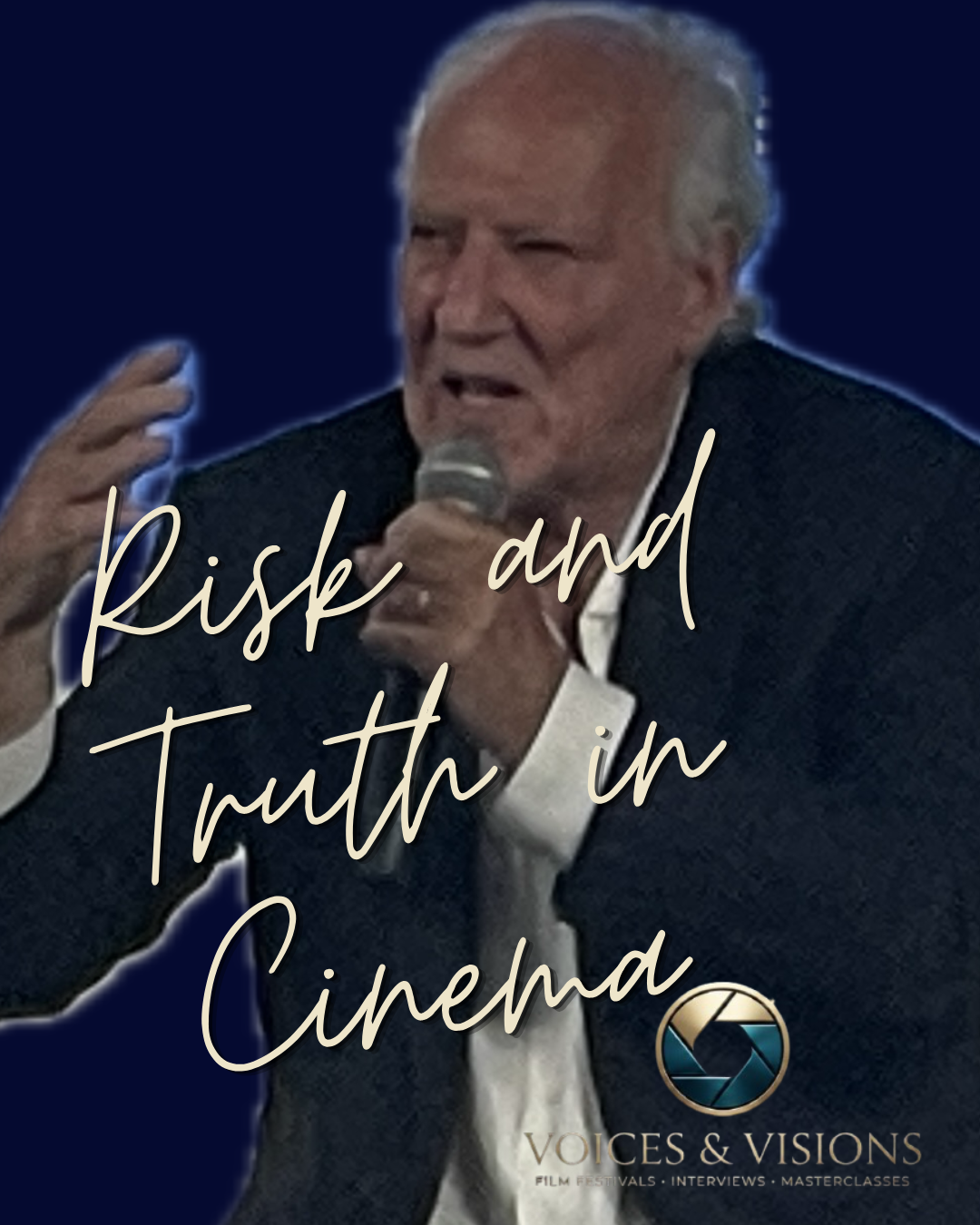
Risk and Truth in Cinema
Werner Herzog is far more than a film director. He is an adventurer, a storyteller, a provocateur, and a teacher, a filmmaker who understands cinema as a form of survival.
At the 2025 Venice Film Festival, he was awarded the Golden Lion for Lifetime Achievement, receiving the honor with modesty and a promise to keep working:
“I feel deeply honored to receive an Honorary Golden Lion for my entire body of work at the Venice Biennale. I have always tried to be a good soldier of cinema, and this feels like a medal for my work. Thank you.”
Herzog emphasized that this accolade does not mark the end of his career:
“I am not retired. I am working as always… I am not done yet.”
Festival Director Alberto Barbera praised Herzog as a “visionary humanist” and the “last heir to the great tradition of German Romanticism,” describing his work as both fascinating and perilous because it demands total dedication and the courage to take physical risks. Herzog tirelessly searches for “unseen images” beyond the obvious that expand our understanding of cinema.
The award was presented by none other than Francis Ford Coppola. In his laudation, Coppola expressed his deep admiration:
“It is to be celebrated that someone like him can exist.”
He recalled how films like The Enigma of Kaspar Hauser, Aguirre, the Wrath of God, and Fitzcarraldo had profoundly impacted him and how Herzog’s work had permeated his life. He praised the filmmaker’s versatility and concluded with a challenge that stands as a lasting benchmark:
“If Werner has limits, I don’t know what they are. Werner’s life and existence are a challenge to all: Copy him if you can.”
Herzog sees himself as someone who works with discipline, courage, and utter devotion. Fear has no place in his vocabulary. This stance is no mere gesture, but the result of a life that has constantly sought out extreme situations: filming in jungles, on glaciers, near volcanoes, or in deserts. Remarkably, his detachment from contemporary cinema is striking:
“Perhaps I see five or six films a year. But I read.”
For him, literature, such as J.A. Baker’s The Peregrine, is essential. It sharpens observation and lends depth to his films.
“Every adult must overcome their own ‘mountains.’ Men symbolically pull boats over mountains; women find their own ways, but all must face a great and difficult task.”
Physical challenges, whether in sports, dangerous situations, or hard work, also strengthen mental resilience. Herzog deeply distrusts theories: in his workshops, students shoot short films in just nine days; they scout locations, find non-professional actors, write shooting schedules, and improvise.
“Often they learn more in nine days than in four years at university.”
Herzog financed his early films with jobs as a welder, night watchman, or factory hand. His advice: do not wait for the industry; realize your projects with your own means.
“Today you can make films for less than 10,000 euros.”
Many of his films were created under extreme conditions: shoots without permits, risky scenes, or spontaneous moments. Herzog does not view this as a restriction, but as a creative force. Authenticity arises when you go where life pulses:
“If you really want to tell a story, go where it happens.”
Music does not merely accompany; it forms the dramatic center. Often, Herzog sits in the studio, dictates rhythm and tone, and even asks Richard Thompson to play barefoot so the energy hits more directly.
As relentless as he is in his work, his private joys are simple: reading, cooking, swimming, spending time with cats. These moments, he says, are “moments that nourish creativity.”
Werner Herzog remains a role model for a cinema that crosses boundaries, creating images that linger in the memory, such as the underwater elephants in his recent documentary Ghost Elephants.
Herzog’s films are not finished products, but expeditions: risky, poetic, and often daring. They explore the forces of nature, obsessions, and the fragility of human existence. His “ecstatic truth” goes beyond mere facts, guiding the audience to the edge and making the unspeakable visible.
His legacy for young filmmakers can be summarized as follows: Be brave and take risks. Do not wait for the industry; take action yourself. Read, observe, go where life happens. Use resources wisely and shoot only what truly matters.
Cinema as a survival strategy: Between jungles, glaciers, and ecstatic truth, how Werner Herzog, the last romantic rebel of film, redefines the art of uncompromising storytelling.
#WernerHerzog #Filmmaking #Cinephile #FilmDirector #IndependentFilm #Cinema #Directing #GoldenLion #VeniceFilmFestival #LifetimeAchievement #FilmHistory
More dropping soon! Follow on IG so you don’t miss it!