
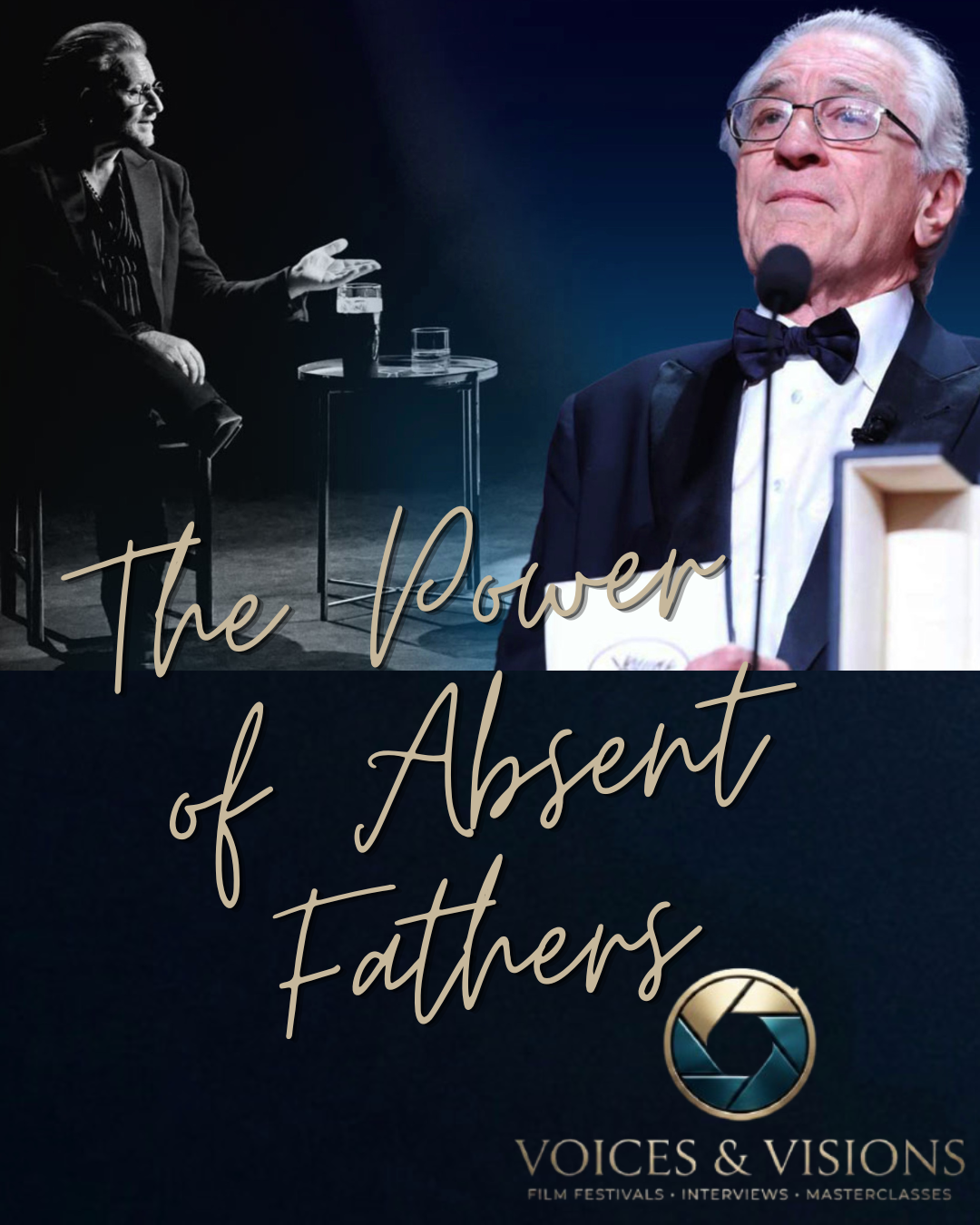
The Power of Absent Fathers
At the 78th Cannes Film Festival, two globally renowned cultural figures, at the pinnacle of global fame, chose not to project authority, but to question its origin. In Bono: Stories of Surrender and in Robert De Niro’s quietly defiant masterclass, what emerged was not legacy itself, but a reckoning with its source: the father. Not the mythical, pedagogical, or symbolic father of political allegory or psychological theory, but the absent, unreachable, emotionally distant figure who shapes identity precisely through silence.
For Bono, the personal is inextricably bound to the performative. His film is not simply a retrospective, but an exorcism: a dialogue with the memory of Bob Hewson, a father who offered no praise and, perhaps more crucially, no words. Bono’s characteristic ease with topics like justice, music, and diplomacy contrasts with a paternal silence that remains unreadable. In one of the film’s most vulnerable moments, he reflects:
“I was afraid of being better than him, not because I was, but because it might distance me from him.”
This single sentence encapsulates a deeply recognizable structure of inheritance: to surpass the father is to risk the connection.
De Niro’s appearance in Cannes, nearly wordless in a masterclass alongside visual artist JR, addresses a parallel void. Rather than recapping his career highlights, De Niro turns his gaze to the personal sphere: his father, the painter Robert De Niro Sr., who struggled for recognition and identity as a gay man in post-war America. The actor does not romanticize him; he documents the enduring opacity of a relationship defined by distance.
“I didn’t know him well,” De Niro admits. “But I want the world to know him. Or at least to search for what I couldn’t find.”
It is not the son claiming an inheritance, but the realization that he never fully received one.
What unites these two narratives goes beyond biographical coincidence. They articulate a distinct form of late 20th-century male inheritance: one defined not by explicit dominance or ideological instruction, but by emotional restraint, by coded or absent transmission.
Bono and De Niro are not confronting tyrannical patriarchs; they are facing fathers who were marginalized in their own ways, by class, oppression, or history, and whose influence was passed down not through validation, but through ellipsis.
Cannes 2025 was therefore not simply a stage for glamour. It was a dual meditation on what it means to be the child of a man who could not or would not speak.
Both Bono and De Niro attempt to fill that silence not with answers, but with art. In doing so, they expose the paradox at the heart of cultural heritage:
that the most important thing is often what is never said.
What binds both stories together is not transcendence. They are stories of coexistence: with absence, with shadows, with the unresolved. What emerges is a model of power transmission that is non-linear, unstable, and profoundly human. The father, in both cases, does not lead. He lingers in the shadows.
Not through words, but through the gaps they left behind.
#Bono, #DeNiro, #father, #absence, #silence, #grief
More dropping soon! Follow on IG so you don’t miss it!